
Summary
OrionBelt compiles declarative YAML semantic models into dialect-specific SQL across eight databases including BigQuery, Snowflake, DuckDB, and Postgres. You define dimensions, measures, and business logic once, then query by business concept instead of raw schema. The MCP server exposes compilation and execution tools that let Claude translate natural language into governed SQL without writing dialects by hand. It also runs a pgwire endpoint and Flight SQL server, so you can connect BI tools directly to the semantic layer. The companion OrionBelt Analytics server generates RDF ontologies from database schemas to help AI navigate relationships and avoid fan traps. Best for teams standardizing analytical SQL across platforms or building agentic data access with semantic guardrails baked in.


Keep your Mac awake while Claude Code and 40+ AI agents run. Sleeps when they're idle.
One time payment $9 →

Integrate web data into your AI product. One API to scrape website & brand data.
Get API Key Now →
Agent, run crypto. Access onchain data & trade routes via 1inch.
Install now →
On Capafy, your Skill runs online 24/7 as an agent product, and you get paid every time someone uses it.
Start earning →

OrionBelt Semantic Layer and Sidecar
An Open Source Semantic Sidecar for Agentic AI, Analytics, Quality and Governance Systems.
Inject governed semantics into systems that never had them.











OrionBelt Semantic Layer (OBSL) is an open-source Semantic Sidecar for AI, analytics, and governed data systems. It injects governed business semantics into existing platforms without requiring architecture changes or dedicated semantic infrastructure.
Define dimensions, measures, metrics, business rules, and semantic context in declarative YAML models. OBSL compiles and executes them as optimized, dialect-specific SQL across BigQuery, ClickHouse, Databricks, Dremio, DuckDB/MotherDuck, MySQL, PostgreSQL, and Snowflake.
Query using business concepts instead of raw schemas and SQL. The same semantic model can power AI agents, analytics workflows, data quality checks, regulatory and business KPIs, and reporting use cases.
Analytics as Code — and beyond.
Define analytical and business semantics in version-controlled YAML, compile them into executable SQL, DQ rules, KPIs, and semantic context, and execute them through a unified API.
No BI tool in the middle. The entire path from declarative model to executable semantics and query results is programmable, reviewable, and reproducible.
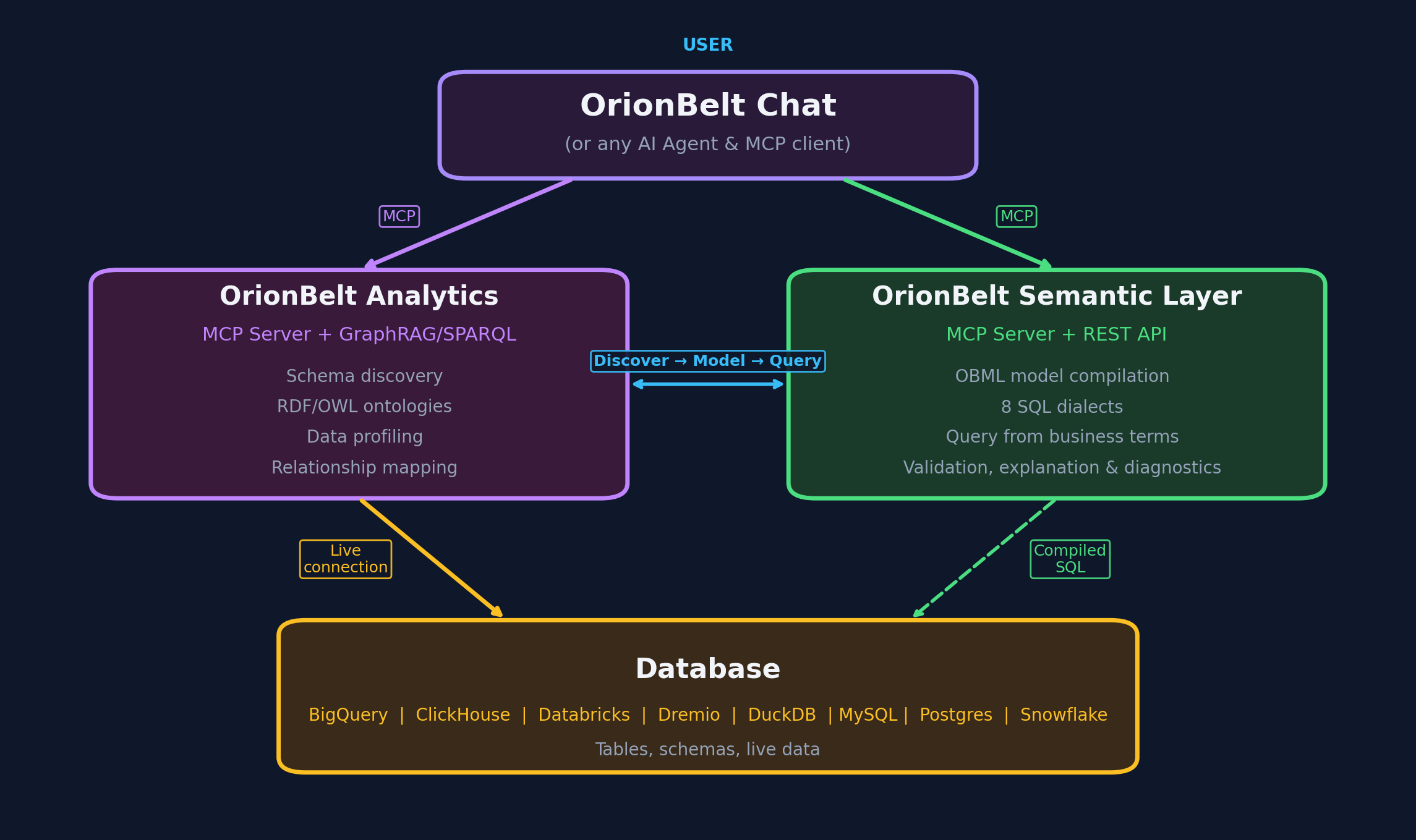
Companion Project: OrionBelt Analytics — an ontology-based MCP server that analyzes database schemas and generates RDF/OWL ontologies. Together they let AI assistants navigate your data landscape through ontologies and compile safe, dialect-aware analytical SQL.
Related reading:
- What is a Semantic Sidecar? — the pattern OBSL implements
- Agentic AI Data Access — governed access for AI agents via MCP
- Governed Text-to-SQL — fan-trap prevention via ontology, AST & MCP
Table of Contents
- Try it in 30 Seconds — Live Demo | Colab | PyPI | uv | Docker
- Claude Desktop / MCP
- Why OrionBelt?
- Features
- Example
- Gradio UI
- Documentation
- Status & Roadmap
- Commercial Offerings
- Companion Project
- Development
Try it in 30 Seconds
Option A: Live Demo (no install)
Open the Live Demo — Gradio UI with a pre-loaded example model. Paste a query, pick a dialect, see SQL instantly.
API explorer: Swagger UI | ReDoc
Want to try the PostgreSQL wire surface? Cloud Run is HTTPS-only, so the public demo can't expose ports 5432 (pgwire) or 8815 (Flight SQL). Spin the same demo up locally in two commands — it includes the baked-in
orionbelt_1_commerceDuckDB dataset and the full OBSQL surface:docker run --rm -d --name orionbelt-demo \ -p 8080:8080 -p 5432:5432 -p 8815:8815 \ -e PGWIRE_ENABLED=true \ -e FLIGHT_ENABLED=true \ ralforion/orionbelt-api:latest # REST + Gradio UI: http://localhost:8080/ui # pgwire (any psql / DBeaver / Tableau / Power BI): psql "host=localhost port=5432 user=obsl dbname=orionbelt_1_commerce sslmode=disable" \ -c 'SELECT "Client Name", "Total Sales" LIMIT 5' # Flight SQL smoke test: uv run python examples/obsql.py 'SELECT "Client Name", "Total Sales" LIMIT 5' docker stop orionbelt-demoThe container ships with
PGWIRE_AUTH_MODE=trust(default), so it's safe forlocalhostbut not safe to expose to the public internet. For exposed deployments, setAUTH_MODE=api_key(shipped in v2.12.0): pgwire then negotiates SCRAM-SHA-256 (or cleartext over TLS) against the shared key store.
Option B: Google Colab (no install)
— Interactive notebook with TPC-H data: explore the model, compile queries across dialects, execute against DuckDB, and see results. Requires Python 3.12 runtime.
Option C: Install from PyPI
pip install orionbelt-semantic-layer
Then paste into a Python REPL:
from orionbelt.parser import ReferenceResolver, TrackedLoader
from orionbelt.compiler.pipeline import CompilationPipeline
from orionbelt.models.query import QueryObject, QuerySelect

model_yaml = """
version: 1.0
dataObjects:
  Orders:
    code: ORDERS
    columns:
      Price: { code: PRICE, abstractType: float }
      Country: { code: COUNTRY, abstractType: string }
dimensions:
  Country:
    dataObject: Orders
    column: Country
    resultType: string
measures:
  Total Revenue:
    resultType: float
    aggregation: sum
    expression: "{[Orders].[Price]}"
"""

loader = TrackedLoader()
raw, source_map = loader.load_string(model_yaml)
resolver = ReferenceResolver()
model, result = resolver.resolve(raw, source_map)

query = QueryObject(select=QuerySelect(dimensions=["Country"], measures=["Total Revenue"]))
pipeline = CompilationPipeline()
output = pipeline.compile(query, model, "postgres")
print(output.sql)
Output:
SELECT
  "Orders"."COUNTRY" AS "Country",
  CAST(SUM("Orders"."PRICE") AS NUMERIC(18, 2)) AS "Total Revenue"
FROM ORDERS AS "Orders"
GROUP BY "Orders"."COUNTRY"
No env file needed — the compilation pipeline is stateless.
Start the servers:
orionbelt-api                              # REST API on :8000 (Swagger UI at /docs, Gradio UI at /ui)
orionbelt-ui                               # standalone Gradio UI on :7860 (connects to API on :8000)
FLIGHT_ENABLED=true orionbelt-api          # API + Arrow Flight SQL on :8815 (DBeaver, Tableau, Power BI)
PGWIRE_ENABLED=true orionbelt-api          # API + PostgreSQL wire on :5432 (Tableau, DBeaver, Superset, psql, Dremio source)
Option C2: Install with uv
uv pip install orionbelt-semantic-layer
uv run orionbelt-api                       # REST API on :8000 (Swagger UI at /docs, Gradio UI at /ui)
uv run orionbelt-ui                        # standalone Gradio UI on :7860 (connects to API on :8000)
FLIGHT_ENABLED=true uv run orionbelt-api   # API + Arrow Flight SQL on :8815 (DBeaver, Tableau, Power BI)
PGWIRE_ENABLED=true uv run orionbelt-api   # API + PostgreSQL wire on :5432 (Tableau, DBeaver, Superset, psql, Dremio source)
Smoke-test the Flight SQL surface without a BI tool:
uv run python examples/obsql.py 'SELECT version()'
uv run python examples/obsql.py 'SHOW TABLES'
uv run python examples/obsql.py 'SELECT "Region", "Total Sales" FROM sales LIMIT 5'

# Multi-model deployment? Pick the model with -m:
uv run python examples/obsql.py -m sales 'SHOW TABLES'
uv run python examples/obsql.py --list   # discover loaded models via REST
Try OBSQL in 30 seconds
OBSQL — OrionBelt Semantic QL — is the SQL surface BI tools and humans actually write. Bare labels, MEASURE() markers, or matching aggregate wrappers; aggregation-match validation; WITH ROLLUP / WITH CUBE; no escape hatch to raw warehouse SQL. Same language over Arrow Flight SQL (v2.4+) and PostgreSQL wire (v2.5+):
PGWIRE_ENABLED=true uv run orionbelt-api &

# Every BI tool already ships a Postgres ODBC/JDBC driver — point yours at :5432
psql "host=localhost port=5432 user=obsl dbname=sales sslmode=disable" \
  -c 'SELECT "Region", "Total Sales" LIMIT 5'

# All three measure forms compile to the same vendor SQL:
psql "..." -c 'SELECT "Region", "Total Sales"        FROM sales LIMIT 5'  -- bare
psql "..." -c 'SELECT "Region", MEASURE("Total Sales") FROM sales LIMIT 5'  -- explicit marker
psql "..." -c 'SELECT "Region", SUM("Total Sales")   FROM sales LIMIT 5'  -- matching aggregate
See the OBSQL reference for the full grammar.
Option D: Docker
Stage 1 — Zero-config start (models loaded later via API or UI):
docker run -p 8080:8080 ralforion/orionbelt-api
Open http://localhost:8080/docs to explore the API.
Stage 2 — Realistic setup with docker compose:
# docker-compose.yml
services:
  api:
    image: ralforion/orionbelt-api:2.16.0
    ports: ["8080:8080"]
    env_file: .env
    volumes:
      - ./models:/app/models:ro
    environment:
      MODEL_FILES: /app/models/my-model.obml.yml

  ui:
    image: ralforion/orionbelt-ui:2.16.0
    ports: ["7860:7860"]
    environment:
      API_BASE_URL: http://api:8080
docker compose up -d
See .env.template for the full environment variable reference.
Docker notes:
API_SERVER_HOSTis already0.0.0.0inside the container — no override needed.- MCP via stdio does not work in Docker. Use the MCP HTTP client for containerized deployments.
- Mount models to
/app/models(or any path) and setMODEL_FILES(comma-separated paths) to pre-load on startup.- For production, pin a version tag (
:2.16.0) rather than:latest.
Claude Desktop / MCP
The MCP server is a separate thin client that delegates to the REST API:
Add to your Claude Desktop claude_desktop_config.json:
{
  "mcpServers": {
    "orionbelt": {
      "command": "uvx",
      "args": ["orionbelt-semantic-layer-mcp"]
    }
  }
}
Also works with Copilot, Cursor, and Windsurf. See the MCP repo for full setup options.
Why OrionBelt?
| OrionBelt | dbt Semantic Layer | Cube | Malloy | |
|---|---|---|---|---|
| Model format | YAML-only (OBML) | Python + YAML | JavaScript | Custom DSL |
| SQL generation | AST-based (injection-safe) | String templates | String templates | Compiler |
| Multi-dialect | 8 dialects, no runtime lock-in | dbt Cloud required | Cube Cloud or self-host | BigQuery-focused |
| Multi-fact queries | Star Schema + CFL planner (fan-trap prevention) | Limited | Pre-aggregations | Automatic joins |
| Integration surface | REST API + MCP + Gradio UI | dbt Cloud API | REST + GraphQL | VS Code extension |
| Deployment | Self-host anywhere, single binary | SaaS (Cloud) | SaaS or self-host | Library |
| License | BSL 1.1 (converts to Apache 2.0) | Apache 2.0 | AGPL / proprietary | MIT |
Features
Semantic Modeling
- OBML Format — YAML-based semantic models with data objects, dimensions, measures, metrics, and joins
- Cross-Schema Queries — model data objects across multiple databases and schemas in a single model
- Static Model Filters — mandatory WHERE conditions baked into the model, auto-applied with join extension
- OBSL Graph & SPARQL — RDF graph export and read-only SPARQL querying for every loaded model
- OSI Interoperability — bidirectional conversion between OBML and Open Semantic Interchange format
SQL Compilation
- 8 SQL Dialects — BigQuery, ClickHouse, Databricks, Dremio, DuckDB/MotherDuck, MySQL, Postgres, Snowflake
- AST-Based Generation — custom SQL AST ensures correct, injection-safe SQL (not string templates)
- Star Schema & CFL — automatic join resolution with Composite Fact Layer for multi-fact queries
- Data Types & Precision — automatic CAST wrapping with dialect-specific type rendering and precision clamping
- Display Formatting — number format patterns (
#,##0.00,0.00%) on measures/metrics with locale-aware rendering - Timezone Settings — auto-detect database session timezone with
defaultTimezonefallback and ISO 8601 serialization - sqlglot Validation — post-generation syntax check across all supported dialects
Integration Surface
- REST API — FastAPI endpoints for model management, validation, compilation, and execution
- MCP Server — separate thin client for Claude, Copilot, Cursor, Windsurf
- AI Integrations — LangChain, OpenAI Agents SDK, CrewAI, Google ADK, Vercel AI SDK, n8n, ChatGPT
- Gradio UI — interactive web interface for model editing, query testing, and ER diagrams
- DB-API 2.0 + Flight SQL — PEP 249 drivers and Arrow Flight SQL server for DBeaver, Tableau, Power BI; ships with
examples/obsql.py, a tiny terminal CLI for testing the Flight surface without a BI tool - PostgreSQL Wire Protocol (v2.5.0+) — native Postgres-protocol surface on
:5432. Every BI tool already ships a Postgres ODBC/JDBC driver, so the user side is "point your existing connection at OBSL and go" — Tableau, DBeaver, Superset, Power BI, plainpsql, and Dremio as a federated Postgres source (Dremio → OBSL → optionally back to Dremio's lakehouse, full circle)
Agent-Facing API
- Model Health on Load — every model load returns a
healthblock with orphan dataObjects, fan-trap risks, and unreachable dimensions — agents skip the defensive second round trip - Query Plan Endpoint —
POST /query/planreturns the planner's understanding (planner choice, physical tables, join path,would_compile) without compiling SQL or executing; opt-ininclude_database_explainadds the warehouse's raw EXPLAIN - Structured Warnings — every
warningslist across the API uses a stable{code, severity, message, path, hint, context}shape with a documented code taxonomy; agents branch on codes instead of parsing messages - Fuzzy
/findRecovery — when a search produces no exact or synonym hits, deterministic Levenshtein + trigram fallback returns near-miss candidates with scores and reasons - Model Examples — optional OBML
examples:block of canonical queries;GET /examples(with?intent=filtering) gives agents one-round-trip discovery of what a model is designed to answer
Freshness-Driven Result Cache
- Source-level freshness contracts — declare
refresh:blocks ondataObjectentries (interval / heartbeat / static); the cache derives query TTLs from the contracts of the physical tables a query touched, not from caller guesses - Heartbeat invalidation — one
POST /v1/heartbeatto a physical table invalidates every cached query that depends on it, across every dataObject and session - DuckDB metadata + Parquet results — file-backed cache with type-precise serialization, lazy expiration, LRU capacity sweep; opt-in via
CACHE_BACKEND=file - Inverts the Cube/dbt/Looker pattern — contracts live on the source, not the semantic abstraction; one source of truth across every cube/explore/saved query reading the table
Developer Experience
- Source-Position Errors — validation errors report exact YAML line and column
- ER Diagrams — interactive Mermaid diagrams with zoom and download (MD/PNG/Turtle)
- Session Management — TTL-scoped sessions with thread-safe model isolation
- JSON Schema — full OBML and query schema for IDE autocompletion (
yaml-language-server)
Example
Define a Semantic Model (OBML)
# yaml-language-server: $schema=https://raw.githubusercontent.com/ralforion/orionbelt-semantic-layer/main/schema/obml-schema.json
version: 1.0
dataObjects:
  Customers:
    code: CUSTOMERS
    database: WAREHOUSE
    schema: PUBLIC
    columns:
      Customer ID: { code: CUSTOMER_ID, abstractType: string }
      Country:     { code: COUNTRY, abstractType: string }

  Orders:
    code: ORDERS
    database: WAREHOUSE
    schema: PUBLIC
    columns:
      Order Customer ID: { code: CUSTOMER_ID, abstractType: string }
      Price:             { code: PRICE, abstractType: float }
      Quantity:          { code: QUANTITY, abstractType: int }
    joins:
      - joinType: many-to-one
        joinTo: Customers
        columnsFrom: [Order Customer ID]
        columnsTo: [Customer ID]

dimensions:
  Country:
    dataObject: Customers
    column: Country
    resultType: string

measures:
  Revenue:
    resultType: float
    aggregation: sum
    expression: "{[Orders].[Price]} * {[Orders].[Quantity]}"
    dataType: "decimal(18, 2)"
Compile via REST API
# Create a session
curl -s -X POST http://localhost:8080/v1/sessions | jq .session_id
# -> "a1b2c3d4"

# Load the model
curl -s -X POST http://localhost:8080/v1/sessions/a1b2c3d4/models \
  -H "Content-Type: application/json" \
  -d '{"model_yaml": "..."}' | jq .model_id
# -> "abcd1234"

# Compile a query
curl -s -X POST http://localhost:8080/v1/sessions/a1b2c3d4/query/sql \
  -H "Content-Type: application/json" \
  -d '{"model_id":"abcd1234","query":{"select":{"dimensions":["Country"],"measures":["Revenue"]}},"dialect":"postgres"}' \
  | jq -r .sql
Generated SQL (Postgres)
SELECT
  "Customers"."COUNTRY" AS "Country",
  CAST(SUM("Orders"."PRICE" * "Orders"."QUANTITY") AS NUMERIC(18, 2)) AS "Revenue"
FROM WAREHOUSE.PUBLIC.ORDERS AS "Orders"
LEFT JOIN WAREHOUSE.PUBLIC.CUSTOMERS AS "Customers"
  ON "Orders"."CUSTOMER_ID" = "Customers"."CUSTOMER_ID"
GROUP BY "Customers"."COUNTRY"
Change dialect to bigquery, clickhouse, databricks, dremio, duckdb, mysql, or snowflake for dialect-specific SQL.
Gradio UI
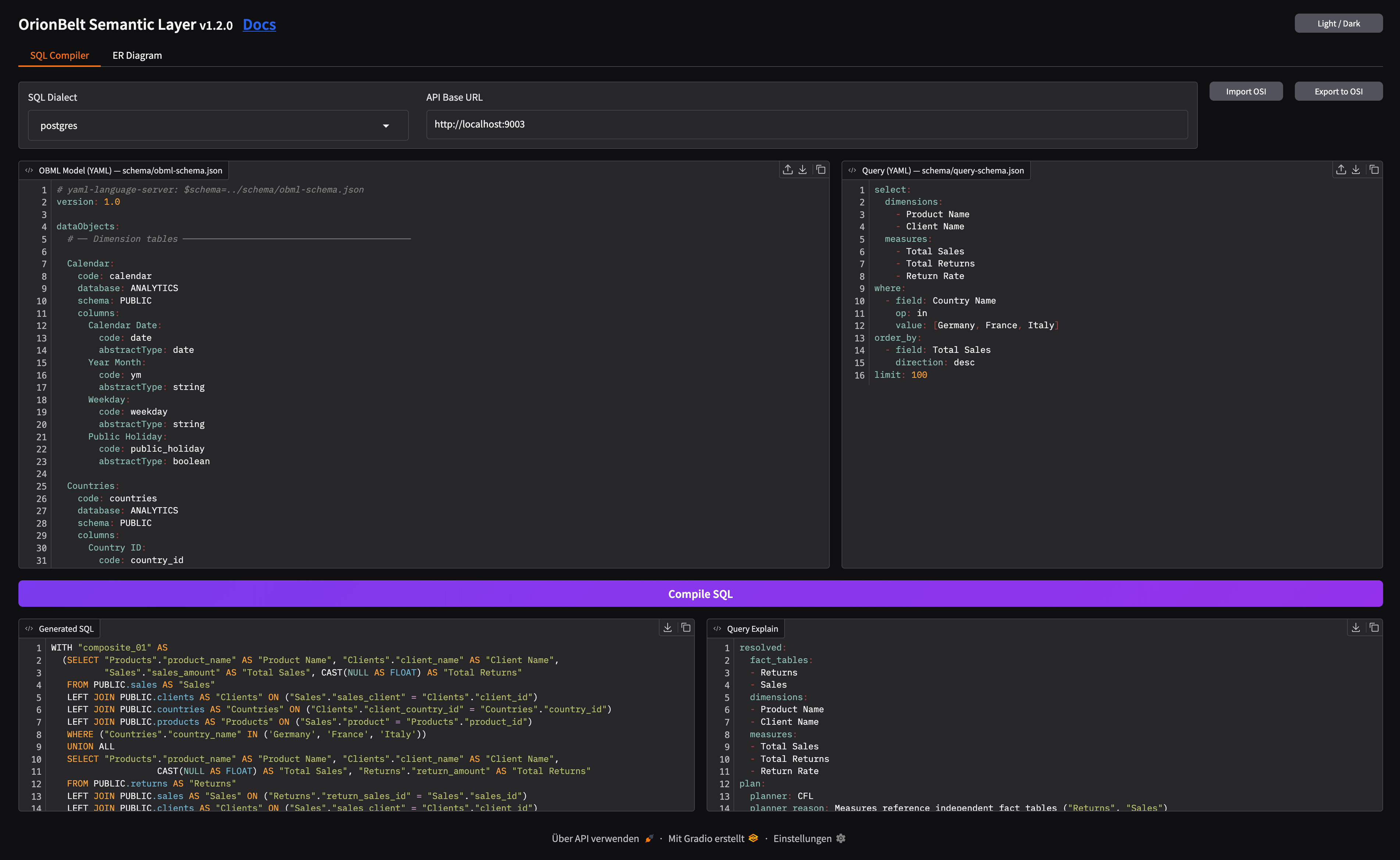
- SQL Compiler — side-by-side OBML model and query editors with syntax highlighting, 8 dialect selector, one-click compilation with formatted SQL output and query explain
- Query Execution — execute compiled queries against a connected database, view results with locale-aware number formatting, response metadata panel, TSV download and clipboard copy (requires
QUERY_EXECUTE=true) - ER Diagram — interactive Mermaid ER diagram with zoom, column toggle, and download (MD/PNG/Turtle)
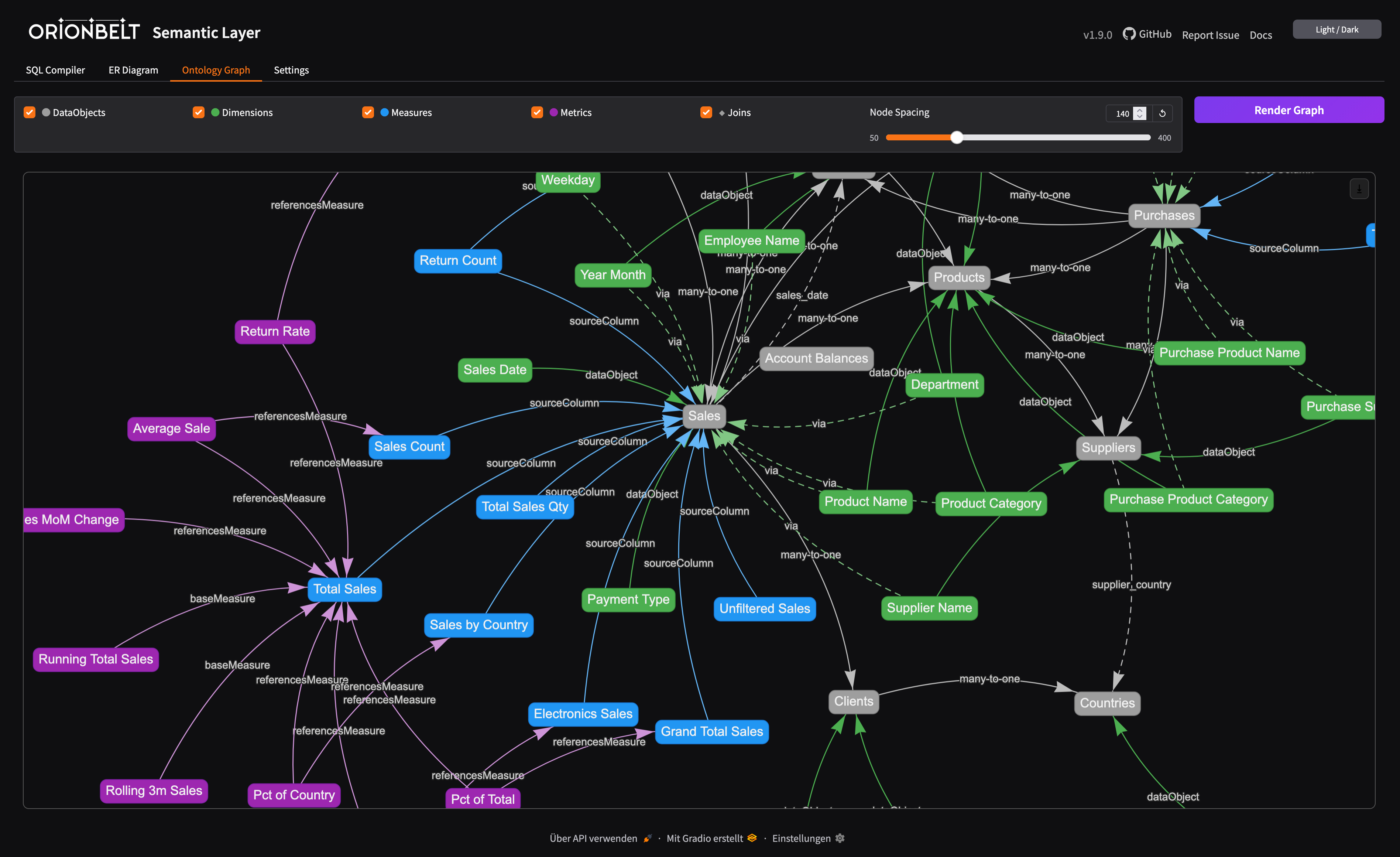
- Ontology Graph — interactive vis-network visualization of the OBML graph (data objects, dimensions, measures, metrics, joins) with toggleable layers and adjustable node spacing
- Editor Toolbar — clear, undo, redo, upload, download, and copy buttons on all code editors
- OSI Import/Export — convert between OBML and OSI formats
- Dark/Light Mode — toggle via header button, state persisted across sessions
Embedded mode — the UI is mounted at /ui on the API server:
pip install orionbelt-semantic-layer && orionbelt-api
# -> UI at http://localhost:8000/ui
Standalone mode — run API and UI as separate processes:
orionbelt-api                                              # API on :8000
orionbelt-ui                                               # UI on :7860 (connects to API on :8000)
API_BASE_URL=http://remote-api:8080 orionbelt-ui           # point UI to a remote API
Documentation
| Topic | Link |
|---|---|
| Full docs site | ralforion.com/orionbelt-semantic-layer |
| Installation | getting-started/installation |
| Quick Start | getting-started/quickstart |
| Docker & Deployment | getting-started/docker |
| Development | getting-started/development |
| OBML Model Format | guide/model-format |
| Query Language | guide/query-language |
| SQL Dialects | guide/dialects |
| Period-over-Period Metrics | guide/period-over-period |
| Trend Analysis (rank / lag / lead / ntile, partitioned MAs, statistical aggregates) | guide/trend-analysis |
| Compilation Pipeline | guide/compilation |
| OBSL Graph & SPARQL | guide/obsl |
| Gradio UI | guide/ui |
| AI Integrations | guide/integrations |
| OSI Interoperability | guide/osi |
| REST API Endpoints | api/endpoints |
| DB-API Drivers & Flight SQL | drivers |
| Architecture | reference/architecture |
| Configuration | reference/configuration |
| Sales Model Walkthrough | examples/sales-model |
| Multi-Dialect Output | examples/multi-dialect |
| Multi-Fact: Sales & Returns | examples/multi-fact |
| TPC-DS Benchmark | examples/tpcds |
| Quickstart Notebook | examples/quickstart.ipynb |
| Comparison: Overview | comparison/ |
| Comparison: vs. dbt Semantic Layer | comparison/dbt |
| Comparison: vs. Malloy | comparison/malloy |
| Comparison: vs. LookML / Looker | comparison/lookml |
| Comparison: vs. Cube | comparison/cube |
| Comparison: vs. AtScale | comparison/atscale |
Status & Roadmap
| Status | Area |
|---|---|
| Shipped | 8 SQL dialects, REST API, MCP server, Gradio UI, DB-API drivers, Flight SQL, PostgreSQL wire protocol (v2.5.0+) — Tableau / DBeaver / Superset / Power BI / psql / Dremio as a federated Postgres source, OBSL/SPARQL, OSI v0.2 interop with bidirectional schema validation, AI integrations (LangChain, CrewAI, ADK, etc.), model inheritance & extends, data types & numerical precision, timezone settings, grain & filter context overrides, Trend Analysis — partitioned rolling windows, MetricType.WINDOW for rank/lag/lead/ntile, 9 statistical aggregates (CORR, COVAR_, REGR_, STDDEV_, VAR_), Unified authentication (v2.12.0) across REST / Flight / pgwire / UI — AUTH_MODE=api_key with shared key store, pgwire SCRAM-SHA-256 + cleartext, Artefacts Composability Resolution (ACR, v2.14.0): a composables endpoint that, given the query so far, returns which dimensions / measures / metrics can still be added (including CFL candidates), powering guided query building |
| Planned | OIDC / SSO authentication & per-token authorization scopes, CLI for automation & CI/CD, DDL view generation (CREATE VIEW from queries), additional dialects, additional BI tool integrations, pre-aggregation / materialization layer |
Commercial Offerings
OrionBelt Semantic Layer is open by default — the OSS distribution has full parity on the shipped v2.6 surface and is production-grade for self-hosted use. For teams that want production support, a managed runtime, or embedded analytics terms, RALFORION offers:
- Embedded analytics license — relicensing terms for shipping OBSL inside a commercial product
- Commercial cloud offering — managed OrionBelt runtime with SLAs
- Enterprise features — capabilities tailored for enterprise deployments
- Consulting + support — implementation, modeling, and production support
Contact RALFORION d.o.o. for details.
Companion Project
OrionBelt Analytics
An ontology-based MCP server that analyzes relational database schemas and generates RDF/OWL ontologies. Together with OrionBelt Semantic Layer, it enables AI assistants to navigate your data landscape through ontologies and compile safe, dialect-aware analytical SQL.
Development
Contributing to OrionBelt or running from source:
git clone https://github.com/ralforion/orionbelt-semantic-layer.git
cd orionbelt-semantic-layer
uv sync                           # install all deps (dev, docs, ui, flight, drivers)
uv run orionbelt-api              # start API on :8000
# Quality
uv run pytest                     # run tests
uv run ruff check src/            # lint
uv run ruff format src/ tests/    # format
uv run mypy src/                  # type check

# Docs
uv sync --extra docs && uv run mkdocs serve  # docs on :8080
License
Copyright 2025 RALFORION d.o.o.
Licensed under the Business Source License 1.1. The Licensed Work will convert to Apache License 2.0 on 2030-03-16.
By contributing to this project, you agree to the Contributor License Agreement.
For commercial licensing inquiries, contact: licensing@ralforion.com

Featured
Keep your Mac awake while Claude Code and 40+ AI agents run. Sleeps when they're idle.
One time payment $9 →Integrate web data into your AI product. One API to scrape website & brand data.
Get API Key Now →Agent, run crypto. Access onchain data & trade routes via 1inch.
Install now →On Capafy, your Skill runs online 24/7 as an agent product, and you get paid every time someone uses it.
Start earning →