
Summary
This connects Claude to a Docker-based Chrome pool that runs browser tests defined as plain JSON arrays. The 16 tools let Claude create test files, execute them in parallel or serial mode, fetch screenshots, read network logs, and pull test results back into the conversation. You can ask it to generate a test from a GitHub issue URL, run visual verification checks by describing what a page should look like, or debug flaky tests using the built-in stability tracker. Tests are action objects like goto, click, type, and assert_text with no Playwright or Cypress wrapper. The dashboard shows live execution, pass rates, and screenshot diffs. If you want Claude to write and run browser tests without leaving the chat, this is the stack.


Keep your Mac awake while Claude Code and 40+ AI agents run. Sleeps when they're idle.
One time payment $9 →

Integrate web data into your AI product. One API to scrape website & brand data.
Get API Key Now →
Agent, run crypto. Access onchain data & trade routes via 1inch.
Install now →
On Capafy, your Skill runs online 24/7 as an agent product, and you get paid every time someone uses it.
Start earning →
English · Español
@matware/e2e-runner
The AI-native E2E test runner that writes, runs, and debugs tests for you.










E2E Runner lets you test your web app without writing test code. Tests are plain JSON — and you don't even have to write that yourself: just ask Claude Code.
🎬 Write a test by asking — then watch it run
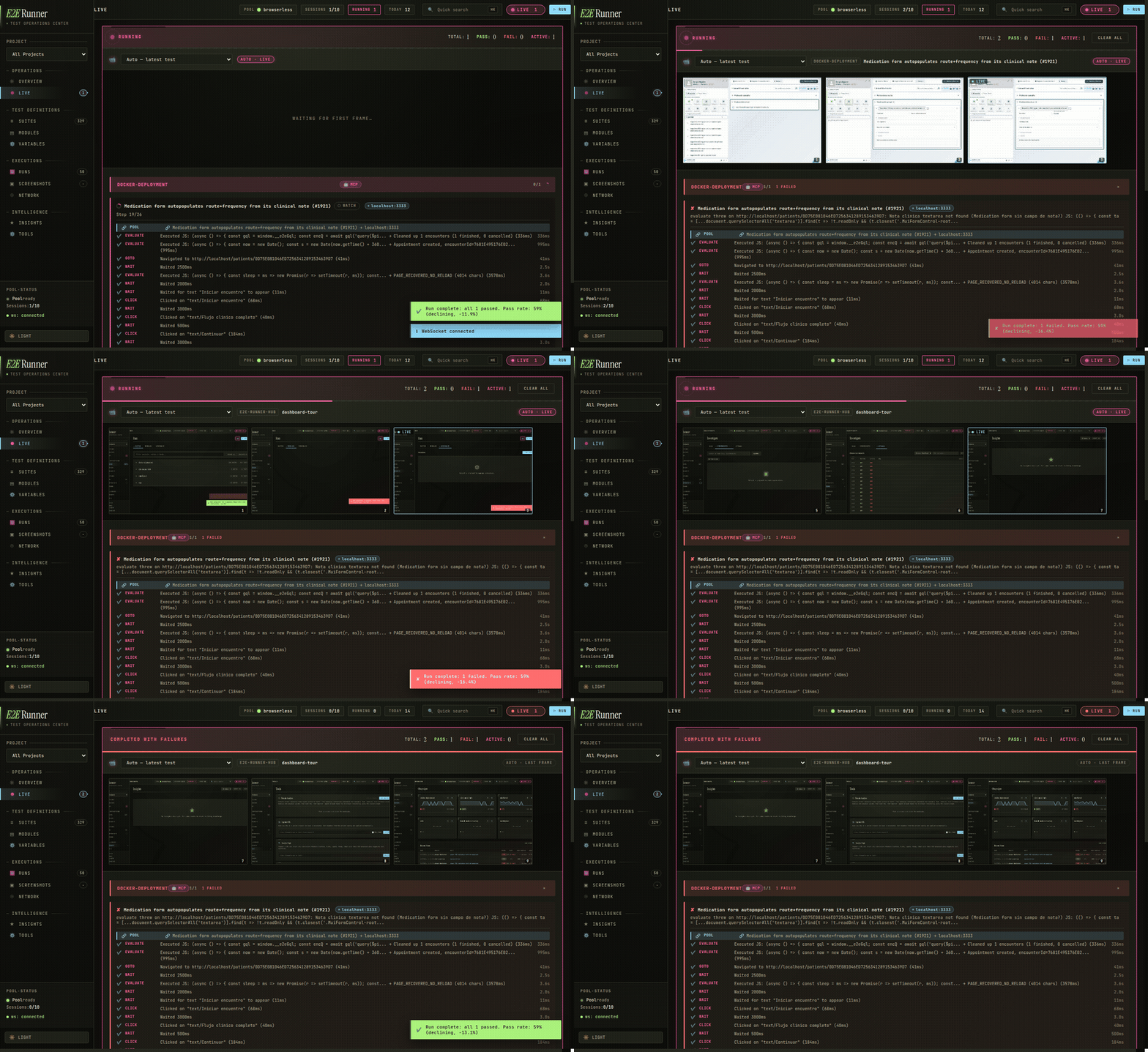
The live dashboard while a suite runs — every step streams a screenshot into the feed, in real time.
With the built-in MCP server, creating a test is a conversation — no docs, no syntax to memorize:
You: Create an E2E test for the login flow and run it.
Claude Code: writes the test, runs it in a real browser, and reports back — ✅
login-flowpassed in 2.3s · screenshot saved · no network errors.
Behind the scenes Claude just wrote and ran this. A test is just JSON — an ordered list of what a user does:
[
  { "name": "login-flow", "actions": [
    { "type": "goto", "value": "/login" },
    { "type": "type", "selector": "#email", "value": "user@test.com" },
    { "type": "type", "selector": "#password", "value": "secret" },
    { "type": "click", "text": "Sign In" },
    { "type": "assert_text", "text": "Welcome back" },
    { "type": "screenshot", "value": "logged-in.png" }
  ]}
]
No imports, no describe/it, no build step. If you can read it you can write it — or just ask.
Connect it to Claude Code (2 commands):
claude plugin marketplace add fastslack/mtw-e2e-runner
claude plugin install e2e-runner@matware
Now say "create a test for X and run it" — Claude gets 17 MCP tools, slash commands, and specialized agents.
Using a different agent (Cursor, Codex, Copilot, 40+ more)? Install the skill:
npx skills add fastslack/mtw-e2e-runner
📖 Contents
| Section | What's inside | |
|---|---|---|
| 🚀 | Install & first test | npm setup · run with your own Chrome (no Docker), Obscura, or a Docker pool |
| ✨ | What you get | feature overview at a glance |
| ✍️ | Writing tests | test format · full action catalog · retries · serial · modules · auth · hooks |
| 🤖 | AI integration | Claude Code · OpenCode · 17 MCP tools · visual verification · issue-to-test |
| 📊 | Dashboard & insights | live dashboard · learning system · network logs · screenshot capture |
| 🌐 | Browser drivers | browserless · cdp · lightpanda · obscura · steel |
| ⚙️ | CLI, config & CI | commands · flags · e2e.config.js · GitHub Actions · programmatic API |
🚀 Install — it's tiny
npm install --save-dev @matware/e2e-runner
npx e2e-runner init        # scaffolds e2e/ with a sample test + config
Then pick how to run the browser. You don't need Docker unless you want the parallel pool:
Option 1 · Use the Chrome you already have — no Docker ⭐
Launch any Chromium browser with a debugging port, then point the runner at it:
google-chrome --headless=new --remote-debugging-port=9222 &   # or brave / chromium / msedge
CHROME_POOL_URL=http://localhost:9222 POOL_DRIVER=cdp npx e2e-runner run --all
Or bake it into e2e.config.js so you never repeat it:
export default {
  baseUrl: 'http://localhost:3000',     // your app — plain localhost, no docker hostname
  poolUrls: ['http://localhost:9222'],
  poolDriver: 'cdp',
};
Nothing to install beyond npm, and baseUrl is just localhost (the browser is on your machine).
Option 2 · Obscura — one tiny binary, no Docker
A single ~30 MB binary with built-in anti-detection. Install once, run it, point the runner at it:
obscura serve --port 9222 --stealth &
CHROME_POOL_URL=http://localhost:9222 POOL_DRIVER=obscura npx e2e-runner run --all
npx e2e-runner pool start (with poolDriver: 'obscura' in your config) prints the exact install command for your OS.
Option 3 · Docker pool — parallel, for CI & big suites
A shared, queue-managed Chrome pool that runs many tests at once:
npx e2e-runner run --all # the first run auto-starts the Docker pool for you
Requires Docker. Set baseUrl: 'http://host.docker.internal:3000' so the containerized Chrome can reach your app.
Why host.docker.internal (Docker option only)?
With the Docker pool, Chrome runs inside a container, so localhost there means the container — not your machine. host.docker.internal bridges to your host. On Linux (Docker Engine, not Docker Desktop) add --add-host=host.docker.internal:host-gateway, or use your LAN IP. Options 1 & 2 don't have this — the browser is local, so plain localhost just works.
Write your first test
Open e2e/tests/sample.json — a flow is an ordered list of actions:
[
  { "name": "homepage loads", "actions": [
    { "type": "goto", "value": "/" },
    { "type": "assert_text", "text": "Welcome" },
    { "type": "screenshot", "value": "home.png" }
  ]}
]
Run it with npx e2e-runner run --all. Results — pass/fail, timing, screenshots, network errors — print to your terminal and to the web dashboard if it's open.
Add OpenCode (optional)
cp node_modules/@matware/e2e-runner/opencode.json ./
mkdir -p .opencode && cp -r node_modules/@matware/e2e-runner/.opencode/* .opencode/
See OPENCODE.md for details.
Updating
Each install method updates separately — bump the one(s) you use:
# npm dependency (per project)
npm install --save-dev @matware/e2e-runner@latest

# Claude Code plugin
claude plugin update e2e-runner@matware

# MCP-only install (npx caches the package — pin @latest to force a refresh)
claude mcp add --transport stdio --scope user e2e-runner \
  -- npx -y -p @matware/e2e-runner@latest e2e-runner-mcp
[!NOTE] Two gotchas: (1)
npxprefers a copy found in the project'snode_modulesover its own cache — if a project pins an old version, the MCP server and dashboard run that old version, so update the project dependency too. (2) Already-running processes keep the old code in memory: after updating, restart the dashboard and reconnect the MCP server (/mcp→e2e-runner→ Reconnect, or restart your session).
✨ What you get
🧪 Zero-code tests — JSON files that anyone on your team can read and write. No JavaScript, no compilation, no framework lock-in.
🤖 AI-powered testing — Claude Code creates, executes, and debugs tests natively through 17 MCP tools. Ask it to "test the checkout flow" and it builds the JSON, runs it, and reports back.
🐛 Issue-to-Test pipeline — Paste a GitHub or GitLab issue URL. The runner fetches it, generates E2E tests, runs them, and tells you: bug confirmed or not reproducible.
👁️ Visual verification — Describe what the page should look like in plain English. The AI captures a screenshot and judges pass/fail against your description. No pixel-diffing setup needed.
🧠 Learning system — Tracks test stability across runs. Detects flaky tests, unstable selectors, slow APIs, and error patterns — then surfaces actionable insights.
⚡ Parallel execution — Run N tests simultaneously against a shared browser pool (browserless, raw CDP, Lightpanda, Obscura, or Steel). Serial mode available for tests that share state.
🎯 Pluggable browser drivers — Pick the engine that fits each test: real Chrome via browserless, Lightpanda or Obscura for fast lightweight runs, Steel for managed sessions. Set driver per test or override the whole run with --driver.
📊 Real-time dashboard — Live execution view, run history with pass-rate charts, screenshot gallery with hash-based search, expandable network request logs.
🔁 Smart retries — Test-level and action-level retries with configurable delays. Flaky tests are detected and flagged automatically.
📦 Reusable modules — Extract common flows (login, navigation, setup) into parameterized modules and reference them with $use.
🏗️ CI-ready — JUnit XML output, exit code 1 on failure, auto-captured error screenshots. Drop-in GitHub Actions example included.
🌐 Multi-project — One dashboard aggregates test results from all your projects. One Chrome pool serves them all.
🐳 Portable — Chrome runs in Docker, tests are JSON files in your repo. Works on any machine with Node.js and Docker.
✍️ Writing tests
Everything about authoring tests — the file format, the full action vocabulary, retries, state isolation, and reuse. Expand what you need:
Test format & file layout
Each .json file in e2e/tests/ contains an array of tests. Each test has a name and sequential actions:
[
  {
    "name": "homepage-loads",
    "actions": [
      { "type": "goto", "value": "/" },
      { "type": "assert_visible", "selector": "body" },
      { "type": "assert_url", "value": "/" },
      { "type": "screenshot", "value": "homepage.png" }
    ]
  }
]
Suite files can have numeric prefixes for ordering (01-auth.json, 02-dashboard.json). The --suite flag matches with or without the prefix, so --suite auth finds 01-auth.json.
Action catalog — navigation, input & interaction
| Action | Fields | Description |
|---|---|---|
goto | value | Navigate to URL (relative to baseUrl or absolute) |
click | selector or text | Click by CSS selector or visible text content. Text mode also takes scope: "dialog", visible: true, last: true |
type / fill | selector, value | Clear field and type text |
wait | selector, text, gone, or value (ms) | Wait for element/text to appear, for gone to disappear (spinner/dialog), or fixed delay. Prefer conditions over fixed value sleeps |
screenshot | value (filename) | Capture a screenshot |
select | selector, value | Select a dropdown option |
clear | selector | Clear an input field |
press | value | Press a keyboard key (Enter, Tab, etc.) |
scroll | selector or value (px) | Scroll to element or by pixel amount |
hover | selector | Hover over an element |
evaluate | value | Execute JavaScript in the browser context |
navigate | value | Browser navigation (back, forward, reload) |
clear_cookies | — | Clear all cookies for the current page |
wait_network_idle | optional value (idle ms, default 500), timeout | Wait until the network has been idle for value ms — useful after actions that trigger background requests |
set_storage | value ("key=val"), optional selector: "session" | Set a localStorage key (or sessionStorage with selector: "session") |
gql | value (query), optional text (variables JSON), optional selector (assertion) | Run a GraphQL query/mutation via in-page fetch, with the auth token read from localStorage. Fails on GraphQL errors. selector is a JS expression asserted against the response r (e.g. "r.data.users.length > 0"). Installs window.__e2eGql for later evaluate steps |
Click by text — when click uses text instead of selector, it searches across common interactive and content elements:
button, a, [role="button"], [role="tab"], [role="menuitem"], [role="option"],
[role="listitem"], div[class*="cursor"], span, li, td, th, label, p, h1-h6
{ "type": "click", "text": "Sign In" }
Assertions — verify text, elements, URLs, counts & network
| Action | Fields | Description |
|---|---|---|
assert_text | text | Assert text exists anywhere on the page (substring) |
assert_no_text | text | Assert text does NOT appear anywhere on the page — opposite of assert_text |
assert_text_in | selector, text, optional value: "exact" | Assert text inside a scoped container. text is a case-insensitive regex by default; value: "exact" switches to case-sensitive substring |
assert_element_text | selector, text, optional value: "exact" | Assert element's text contains (or exactly matches) the expected text |
assert_url | value | Assert current URL path or full URL. Paths (/dashboard) compare against pathname only |
assert_visible | selector | Assert element exists and is visible |
assert_not_visible | selector | Assert element is hidden or doesn't exist |
assert_attribute | selector, value | Check attribute: "type=email" for value, "disabled" for existence |
assert_class | selector, value | Assert element has a CSS class |
assert_input_value | selector, value | Assert input/select/textarea .value contains text |
assert_matches | selector, value (regex) | Assert element text matches a regex pattern |
assert_count | selector, value | Assert element count: exact ("5"), or operators (">3", ">=1", "<10") |
assert_no_network_errors | — | Fail if any network requests failed (e.g. ERR_CONNECTION_REFUSED) |
assert_storage | value ("key" or "key=expected"), optional selector: "session" | Assert a localStorage/sessionStorage key exists or has a specific value |
assert_visual | value (golden image), optional selector, text (max diff, e.g. "0.02"), fullPage, maskRegions, threshold | Visual regression: compare a screenshot against a golden reference. The first run saves the golden; later runs fail if more pixels differ than the threshold (default 2%) and write a diff image |
get_text | selector | Extract element text (non-assertion, never fails). Result: { value: "..." } |
Framework-aware actions — React/MUI without evaluate boilerplate
These actions handle common patterns in React/MUI apps that normally require verbose evaluate boilerplate:
| Action | Fields | Description |
|---|---|---|
type_react | selector, value, optional blur, waitAfter | Type into React controlled inputs using the native value setter. Dispatches input + change events so React state updates correctly. blur: true commits on blur; waitAfter: "<ms>" waits after (debounced autocomplete). |
click_regex | text (regex), optional selector, optional value: "last" | Click element whose textContent matches a regex (case-insensitive). Default: first match. Use value: "last" for last match. |
click_option | text | Click a [role="option"] element by text — common in autocomplete/select dropdowns. |
select_combobox | text, optional selector, filter, openWait/filterWait/waitAfter | Open a MUI Autocomplete/Select, optionally type filter, then click the option matching text. Falls back across [role="option"], .MuiAutocomplete-option, li.MuiMenuItem-root. |
focus_autocomplete | text (label text) | Focus an autocomplete input by its label text. Supports MUI and generic [role="combobox"]. |
click_chip | text | Click a chip/tag element by text. Searches [class*="Chip"], [class*="chip"], [data-chip]. |
click_icon | value (icon id), optional selector (scope) | Click an icon by data-testid/data-icon/aria-label/class fragment or SVG <title> — MUI, FontAwesome, Heroicons, etc. Clicks the nearest clickable ancestor (button, link, tab). |
click_menu_item | text, optional selector (scope) | Click a menu item by text across [role="menuitem"], .dropdown-item, .menu-item, MUI MenuItem. |
click_in_context | text (container text), selector (child) | Click a child element inside the smallest container matching text — e.g. the delete button of one specific card/row. |
// Before: 5 lines of evaluate boilerplate
{ "type": "evaluate", "value": "const input = document.querySelector('#search'); const nativeSet = Object.getOwnPropertyDescriptor(window.HTMLInputElement.prototype, 'value').set; nativeSet.call(input, 'term'); input.dispatchEvent(new Event('input', {bubbles: true})); input.dispatchEvent(new Event('change', {bubbles: true}));" }

// After: 1 action
{ "type": "type_react", "selector": "#search", "value": "term" }
Multi-tab actions — popups, OAuth windows & cross-tab flows
| Action | Fields | Description |
|---|---|---|
open_tab | value (URL), optional text (label) | Open a new tab and navigate to the URL (relative to baseUrl or absolute). Label defaults to tab-<n> |
switch_tab | value | Switch the active tab by label, numeric index, or title/URL match (regex or substring). "default" returns to the original tab |
wait_for_tab | optional text (label), timeout | Wait for a new tab/popup opened by the app (window.open, target="_blank") and make it the active tab |
assert_tab_count | value | Assert the number of open tabs: exact ("2") or operators (">=2") |
close_tab | optional value (label) | Close the current (or named) tab and switch back to the last remaining one |
All subsequent actions run in the active tab:
{ "type": "click", "text": "Open report" }
{ "type": "wait_for_tab", "text": "report" }
{ "type": "assert_text", "text": "Quarterly results" }
{ "type": "close_tab" }
Retries & flaky detection
Test-level retry — retry an entire test on failure. Set globally via config or per-test:
{ "name": "flaky-test", "retries": 3, "timeout": 15000, "actions": [...] }
Tests that pass after retry are flagged as flaky in the report and learning system.
Action-level retry — retry a single action without rerunning the entire test. Useful for timing-sensitive clicks and waits:
{ "type": "click", "selector": "#dynamic-btn", "retries": 3 }
{ "type": "wait", "selector": ".lazy-loaded", "retries": 2 }
Set globally: actionRetries in config, --action-retries <n> CLI, or ACTION_RETRIES env var. Delay between retries: actionRetryDelay (default 500ms).
Serial tests — for tests that share state
Tests that share state (e.g., two tests modifying the same record) can race when running in parallel. Mark them as serial:
{ "name": "create-patient", "serial": true, "actions": [...] }
{ "name": "verify-patient-list", "serial": true, "actions": [...] }
Serial tests run one at a time after all parallel tests finish — preventing interference without slowing down independent tests.
Testing authenticated apps
The simplest approach — log in via the UI like a real user:
{
  "hooks": {
    "beforeEach": [
      { "type": "goto", "value": "/login" },
      { "type": "type", "selector": "#email", "value": "test@example.com" },
      { "type": "type", "selector": "#password", "value": "test-password" },
      { "type": "click", "text": "Sign In" },
      { "type": "wait", "selector": ".dashboard" }
    ]
  },
  "tests": [...]
}
For SPAs with JWT, skip the login form by injecting the token directly:
{ "type": "set_storage", "value": "accessToken=eyJhbGciOiJIUzI1NiIs..." }
Or set it globally in config:
// e2e.config.js
export default {
  authToken: 'eyJhbGciOiJIUzI1NiIs...',
  authStorageKey: 'accessToken',
};
Each test runs in a fresh browser context, so auth state is automatically clean between tests.
More strategies: Cookie-based auth, HTTP header injection, OAuth/SSO bypasses, reusable auth modules, and role-based testing — see docs/authentication.md
Reusable modules — extract common flows with $use
Extract common flows into parameterized modules:
// e2e/modules/login.json
{
  "$module": "login",
  "description": "Log in via the UI login form",
  "params": {
    "email": { "required": true, "description": "User email" },
    "password": { "required": true, "description": "User password" }
  },
  "actions": [
    { "type": "goto", "value": "/login" },
    { "type": "type", "selector": "#email", "value": "{{email}}" },
    { "type": "type", "selector": "#password", "value": "{{password}}" },
    { "type": "click", "text": "Sign In" },
    { "type": "wait", "value": "2000" }
  ]
}
Use in tests:
{
  "name": "dashboard-loads",
  "actions": [
    { "$use": "login", "params": { "email": "user@test.com", "password": "secret" } },
    { "type": "assert_text", "text": "Dashboard" }
  ]
}
Modules support parameter validation (required params fail fast), conditional blocks ({{#param}}...{{/param}}), nested composition, and cycle detection.
Hooks — beforeAll / beforeEach / afterEach / afterAll
Run actions at lifecycle points. Define globally in config or per-suite:
{
  "hooks": {
    "beforeAll": [{ "type": "goto", "value": "/setup" }],
    "beforeEach": [{ "type": "goto", "value": "/" }],
    "afterEach": [{ "type": "screenshot", "value": "after.png" }],
    "afterAll": []
  },
  "tests": [...]
}
Important:
beforeAllruns on a separate browser page that is closed before tests start. UsebeforeEachfor state that tests need (cookies, localStorage, auth tokens).
Exclude patterns — skip drafts from --all
Skip exploratory or draft tests from --all runs:
// e2e.config.js
export default {
  exclude: ['explore-*', 'debug-*', 'draft-*'],
};
Individual suite runs (--suite) are not affected by exclude patterns.
🤖 AI integration
The whole point: your agent writes, runs, and verifies tests for you.
Claude Code — plugin install & MCP-only install
claude plugin marketplace add fastslack/mtw-e2e-runner
claude plugin install e2e-runner@matware
This gives Claude 17 MCP tools, a workflow skill, 4 slash commands (/e2e-runner:run, /e2e-runner:create-test, /e2e-runner:verify-issue, /e2e-runner:capture), and 3 specialized agents (test-analyzer, test-creator, test-improver).
MCP-only install (tools only, no skill/commands/agents):
claude mcp add --transport stdio --scope user e2e-runner \
  -- npx -y -p @matware/e2e-runner e2e-runner-mcp
OpenCode
cp node_modules/@matware/e2e-runner/opencode.json ./
mkdir -p .opencode && cp -r node_modules/@matware/e2e-runner/.opencode/* .opencode/
See OPENCODE.md for details.
The 17 MCP tools
| Tool | Description |
|---|---|
e2e_run | Run tests (all, by suite, or by file) |
e2e_list | List available test suites |
e2e_create_test | Create a new test JSON file |
e2e_create_module | Create a reusable module |
e2e_pool_status | Check Chrome pool health |
e2e_app_pool_status | Inspect the app environment pool (forks, ports, drivers) |
e2e_screenshot | Retrieve a screenshot by hash |
e2e_capture | Capture screenshot of any URL |
e2e_analyze | Extract page structure (interactive elements, forms, headings) and emit test scaffolds |
e2e_dashboard_start | Start web dashboard |
e2e_dashboard_stop | Stop web dashboard |
e2e_dashboard_restart | Restart the dashboard (new project dir/port, clear stale sessions) |
e2e_issue | Fetch issue and generate tests |
e2e_network_logs | Query network logs for a run |
e2e_learnings | Query stability insights |
e2e_vars | Manage SQLite-backed {{var.KEY}} project variables |
e2e_neo4j | Manage Neo4j knowledge graph |
Pool start/stop are CLI-only — not exposed via MCP.
Visual verification — describe the page, AI judges it
Describe what the page should look like — AI judges pass/fail from screenshots:
{
  "name": "dashboard-loads",
  "expect": "Patient list with at least 3 rows, no error messages, sidebar with navigation links",
  "actions": [
    { "type": "goto", "value": "/dashboard" },
    { "type": "wait", "selector": ".patient-list" }
  ]
}
After test actions complete, the runner auto-captures a verification screenshot. The MCP response includes the screenshot hash — Claude Code retrieves it and visually verifies against your expect description. No API key required.
Issue-to-test — turn a bug report into a runnable test
Turn GitHub and GitLab issues into executable E2E tests. Paste an issue URL and get runnable tests — automatically.
How it works:
- Fetch — Pulls issue details (title, body, labels) via
ghorglabCLI - Generate — AI creates JSON test actions based on the issue description
- Run — Optionally executes the tests immediately to verify if a bug is reproducible
# Fetch and display
e2e-runner issue https://github.com/owner/repo/issues/42

# Generate a test file via Claude API
e2e-runner issue https://github.com/owner/repo/issues/42 --generate

# Generate + run + report
e2e-runner issue https://github.com/owner/repo/issues/42 --verify
# -> "BUG CONFIRMED" or "NOT REPRODUCIBLE"
In Claude Code, just ask:
"Fetch issue #42 and create E2E tests for it"
Bug verification logic: Generated tests assert the correct behavior. Test failure = bug confirmed. All tests pass = not reproducible.
Auth: GitHub requires gh CLI, GitLab requires glab CLI. Self-hosted GitLab is supported.
📊 Dashboard & insights
e2e-runner dashboard                  # Start on default port 8484
e2e-runner dashboard --port 9090      # Custom port
Web dashboard tour — live view, history, gallery, pool status
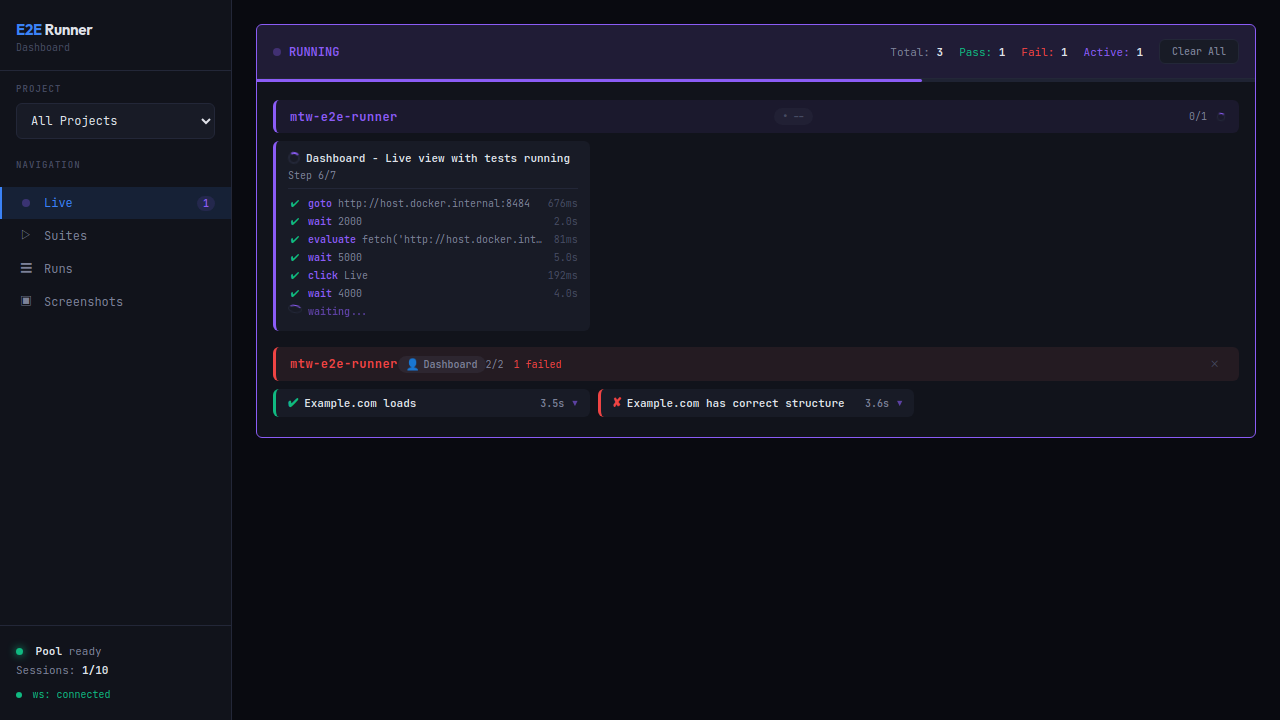
Live execution — monitor tests in real-time with step-by-step progress, durations, and active worker count.
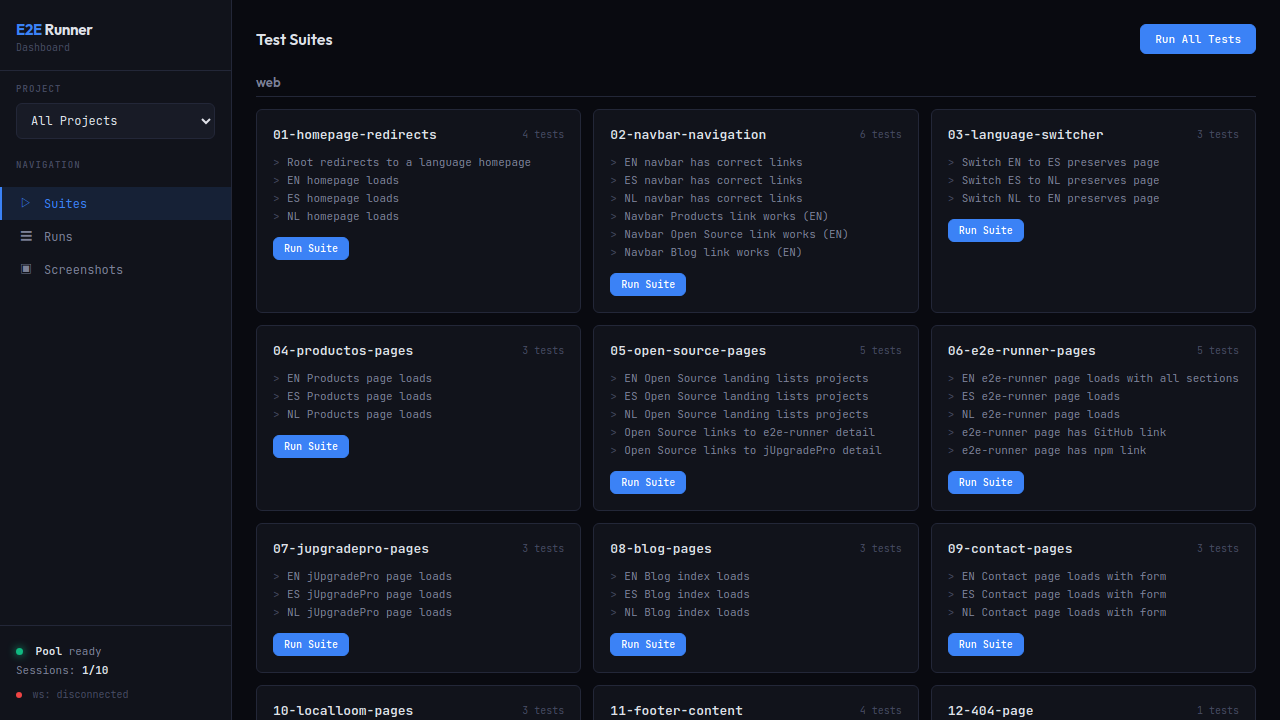
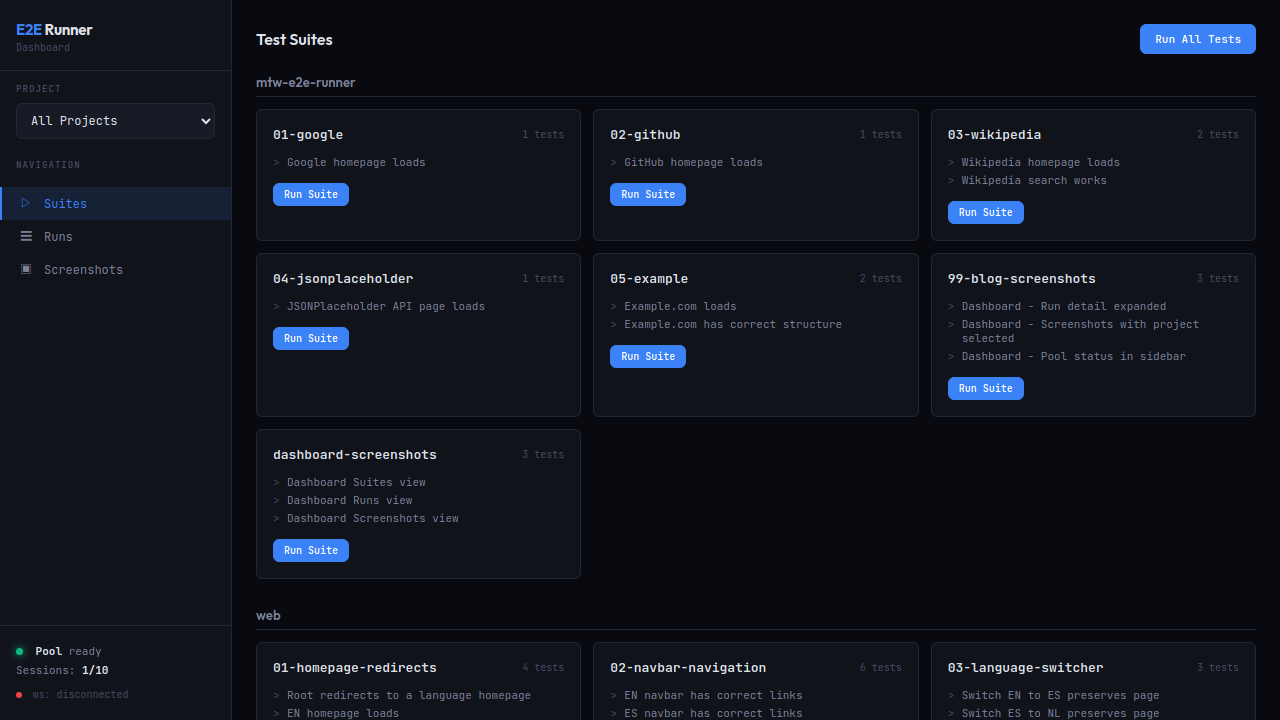
Test suites — browse all suites across projects. Run a single suite or all tests with one click.
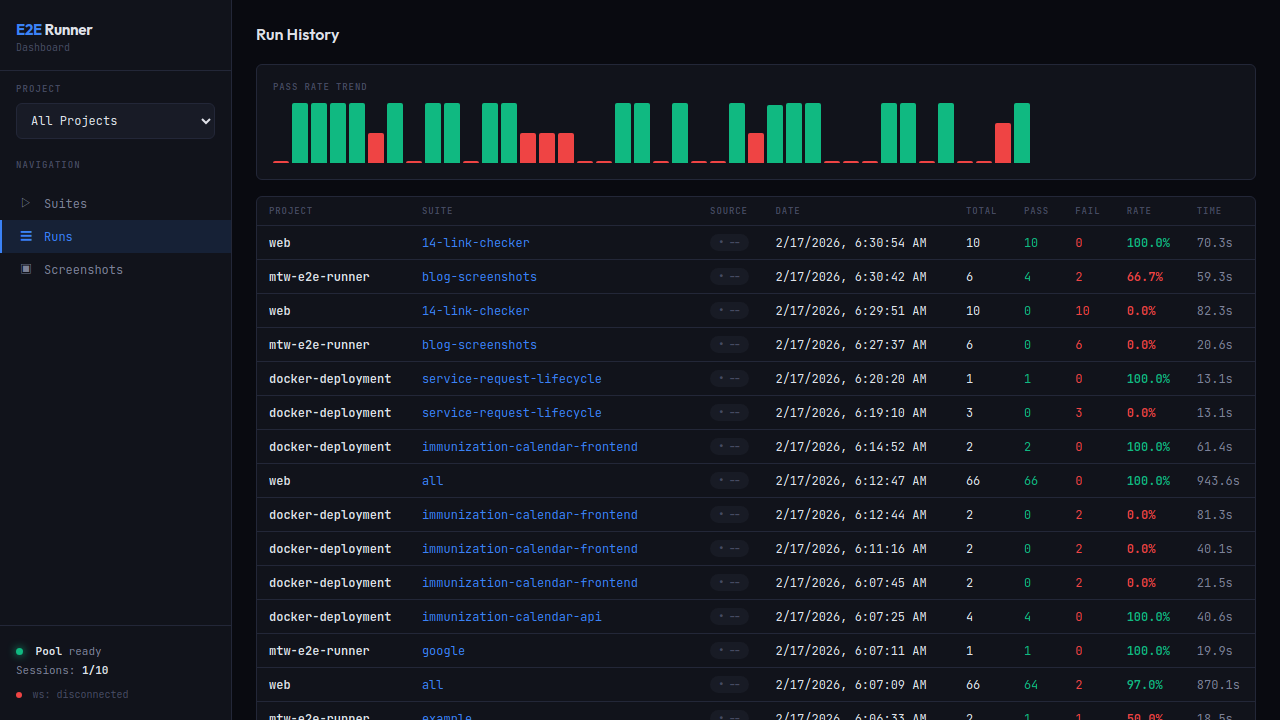
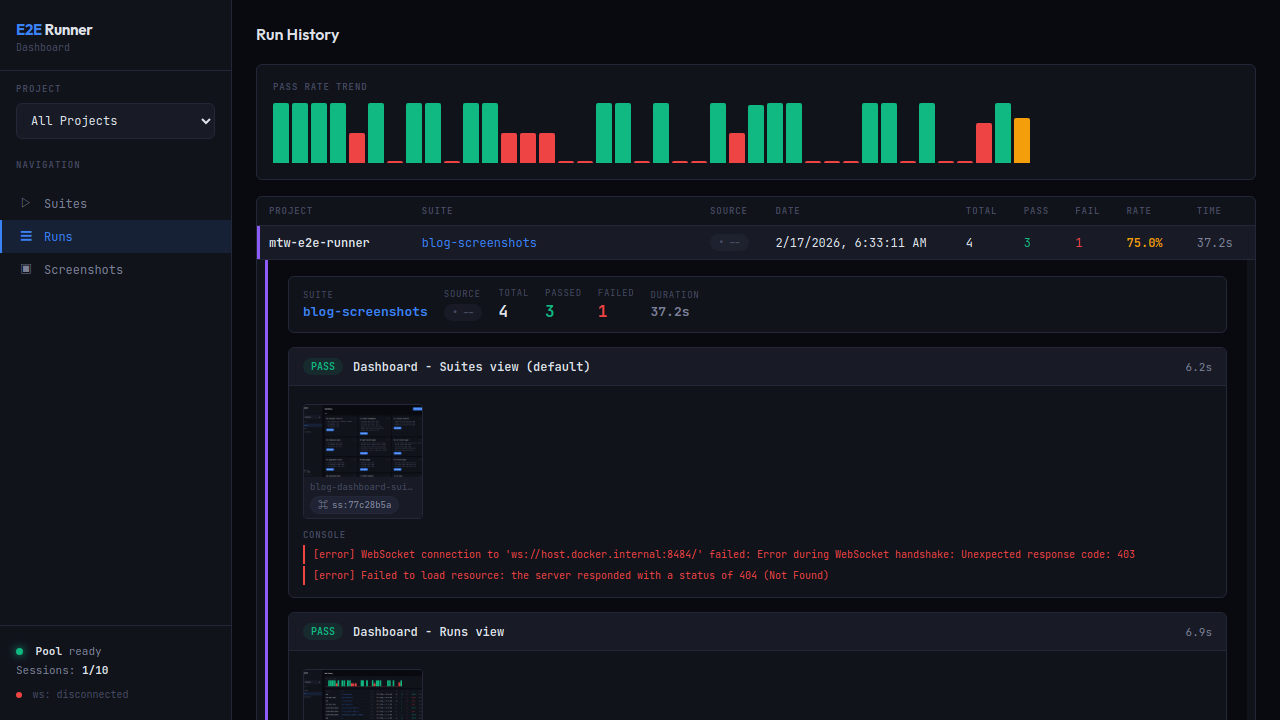
Run history — track pass-rate trends with the built-in chart. Click any row to expand full detail.
Run detail — PASS/FAIL badges, screenshot thumbnails with copyable hashes (ss:77c28b5a), formatted console errors, and network request logs.
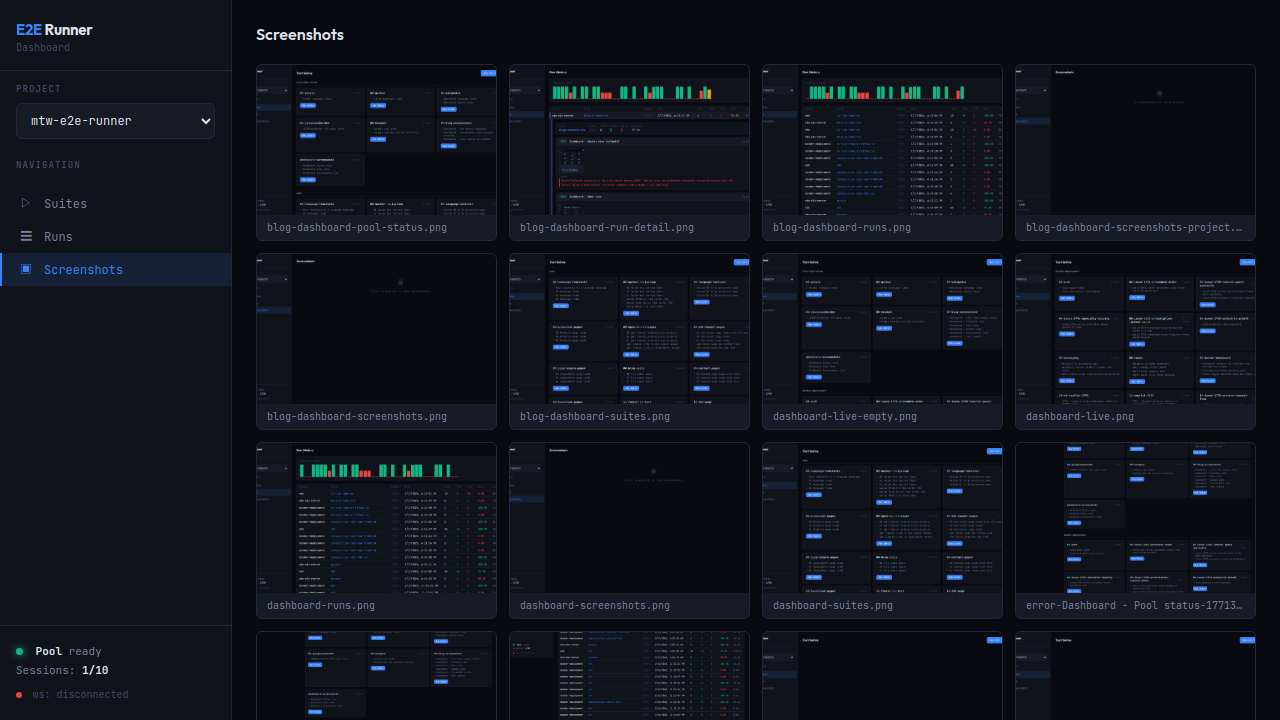
Screenshot gallery — browse all captured screenshots with hash search (action, error, and verification captures).
Pool status — Chrome pool health: available slots, running sessions, memory pressure.
Learning system — flaky tests, unstable selectors, slow APIs
The runner learns from every test run — building knowledge about your test suite over time. Query insights via the e2e_learnings MCP tool:
| Query | Returns |
|---|---|
summary | Full health overview: pass rate, flaky tests, unstable selectors, API issues |
flaky | Tests that pass only after retries |
selectors | CSS selectors with high failure rates |
pages | Pages with console errors, network failures, load time issues |
apis | API endpoints with error rates and latency (auto-normalized: UUIDs, hashes, IDs) |
errors | Most frequent error patterns, categorized |
trends | Pass rate over time (auto-switches to hourly when all data is from one day) |
test:<name> | Drill-down history for a specific test |
page:<path> | Drill-down history for a specific page |
selector:<value> | Drill-down history for a specific selector |
Storage & export:
- SQLite (
~/.e2e-runner/dashboard.db) — default, zero setup - Neo4j knowledge graph — optional, for relationship-based analysis. Manage via
e2e_neo4jMCP tool ordocker compose - Markdown report (
e2e/learnings.md) — auto-generated after each run
Test narration: Each test run generates a human-readable narrative of what happened step by step, visible in the CLI output and the dashboard.
Network error handling — assertions, global flag, full logging
Explicit assertion — place assert_no_network_errors after critical page loads:
{ "type": "goto", "value": "/dashboard" },
{ "type": "wait", "selector": ".loaded" },
{ "type": "assert_no_network_errors" }
Global flag — set failOnNetworkError: true to automatically fail any test with network errors:
e2e-runner run --all --fail-on-network-error
When disabled (default), the runner still collects and reports network errors — the MCP response includes a warning when tests pass but have network errors.
Full network logging — all XHR/fetch requests are captured with URL, method, status, duration, request/response headers, and response body (truncated at 50KB). Viewable in the dashboard with expandable request detail rows.
MCP drill-down flow:
1. e2e_run          → compact networkSummary + runDbId
2. e2e_network_logs(runDbId)                     → all requests (url, method, status, duration)
3. e2e_network_logs(runDbId, errorsOnly: true)   → only failed requests
4. e2e_network_logs(runDbId, includeHeaders: true) → with headers
5. e2e_network_logs(runDbId, includeBodies: true)  → full request/response bodies
The e2e_run response stays compact (~5KB) regardless of how many requests were captured. Use e2e_network_logs with the returned runDbId to drill into details on demand.
Screenshot capture — snapshot any URL on demand
Capture screenshots of any URL on demand — no test suite required:
e2e-runner capture https://example.com
e2e-runner capture https://example.com --full-page --selector ".loaded" --delay 2000
Via MCP, the e2e_capture tool supports authToken and authStorageKey for authenticated pages — it injects the token into localStorage before navigating.
Every screenshot gets a deterministic hash (ss:a3f2b1c9). Use e2e_screenshot to retrieve any screenshot by hash — it returns the image with metadata (test name, step, type).
🌐 Browser drivers
The runner can talk to multiple browser engines through different drivers. The default is auto — it probes each pool URL and picks the right driver per pool.
| Driver | Engine | Detection probe | When to use |
|---|---|---|---|
browserless | Real Chromium via browserless | /pressure returns JSON | Default. Production-grade JS execution, screencast, full Chrome behavior |
cdp | Generic CDP-compatible (raw Chrome, etc.) | /json/version reachable | Fallback for any CDP server that isn't one of the others |
lightpanda | Lightpanda (Zig) | /json/version Browser=lightpanda | ~9× faster, ~16× less memory than headless Chrome — ideal for high-volume scrape-style tests |
obscura | Obscura (Rust + V8) | /json/version Browser=obscura | ~30 MB RAM footprint, built-in anti-detection (--stealth), stays close to real Chrome via Puppeteer |
steel | Steel Browser | /v1/sessions returns JSON | Managed session lifecycle, REST API for orchestration |
Pick a driver per test / force one per run
{
  "tests": [
    {
      "name": "checkout flow (heavy JS, real Chrome)",
      "driver": "browserless",
      "actions": [...]
    },
    {
      "name": "scrape product page (lightweight)",
      "driver": "obscura",
      "fallbackDriver": "cdp",
      "actions": [...]
    }
  ]
}
driver is optional. If set, only pools whose detected driver matches become candidates. fallbackDriver is explicit opt-in — without it, a missing target driver fails the test with a clear message. Pool busyness does not trigger fallback; the runner waits inside the filtered set.
Force a driver for a whole run (CLI overrides win over per-test fields — useful for A/B benchmarks):
e2e-runner run --all --driver obscura
e2e-runner run --all --driver obscura --fallback-driver cdp
Running each driver locally
# browserless (default) — managed by `pool start`
e2e-runner pool start

# Lightpanda — pool start uses templates/docker-compose-lightpanda.yml
e2e-runner pool start                 # with poolDriver: 'lightpanda' in config

# Obscura — install the binary and run it yourself
curl -LO https://github.com/h4ckf0r0day/obscura/releases/latest/download/obscura-x86_64-linux.tar.gz
tar xzf obscura-x86_64-linux.tar.gz
./obscura serve --port 9222 --stealth
# then point the runner at it: poolUrls: ['http://localhost:9222'], poolDriver: 'obscura'
⚙️ CLI, config & CI
CLI commands
# Run tests
e2e-runner run --all                  # All suites
e2e-runner run --suite auth           # Single suite
e2e-runner run --tests path/to.json   # Specific file
e2e-runner run --inline '<json>'      # Inline JSON

# Pool management (CLI only, not MCP)
e2e-runner pool start                 # Start Chrome container
e2e-runner pool stop                  # Stop Chrome container
e2e-runner pool status                # Check pool health

# Issue-to-test
e2e-runner issue <url>                # Fetch issue
e2e-runner issue <url> --generate     # Generate test via AI
e2e-runner issue <url> --verify       # Generate + run + report

# Dashboard
e2e-runner dashboard                  # Start web dashboard

# Other
e2e-runner list                       # List available suites
e2e-runner capture <url>              # On-demand screenshot
e2e-runner init                       # Scaffold project
CLI options
| Flag | Default | Description |
|---|---|---|
--base-url <url> | http://host.docker.internal:3000 | Application base URL |
--pool-url <ws> | ws://localhost:3333 | Chrome pool WebSocket URL |
--concurrency <n> | 3 | Parallel test workers |
--retries <n> | 0 | Retry failed tests N times |
--action-retries <n> | 0 | Retry failed actions N times |
--test-timeout <ms> | 60000 | Per-test timeout |
--timeout <ms> | 10000 | Default action timeout |
--output <format> | json | Report: json, junit, both |
--env <name> | default | Environment profile |
--fail-on-network-error | false | Fail tests with network errors |
--project-name <name> | dir name | Project display name |
--driver <name> | (per-test) | Force pool driver for the run: browserless, cdp, lightpanda, obscura, steel |
--fallback-driver <name> | none | Explicit fallback if no pool with --driver is reachable |
Configuration — e2e.config.js & priority
Create e2e.config.js in your project root:
export default {
  baseUrl: 'http://host.docker.internal:3000',
  concurrency: 4,
  retries: 2,
  actionRetries: 1,
  testTimeout: 30000,
  outputFormat: 'both',
  failOnNetworkError: true,
  exclude: ['explore-*', 'debug-*'],

  hooks: {
    beforeEach: [{ type: 'goto', value: '/' }],
  },

  environments: {
    staging: { baseUrl: 'https://staging.example.com' },
    production: { baseUrl: 'https://example.com', concurrency: 5 },
  },
};
Config priority (highest wins):
- CLI flags
- Environment variables
- Config file (
e2e.config.jsore2e.config.json) - Defaults
When --env <name> is set, the matching profile overrides everything.
CI/CD — JUnit XML & GitHub Actions
e2e-runner run --all --output junit
jobs:
  e2e:
    runs-on: ubuntu-latest
    steps:
      - uses: actions/checkout@v4
      - uses: actions/setup-node@v4
        with:
          node-version: 20
      - run: npm ci
      - run: npx e2e-runner pool start
      - run: npx e2e-runner run --all --output junit
      - uses: mikepenz/action-junit-report@v4
        if: always()
        with:
          report_paths: e2e/screenshots/junit.xml
Programmatic API
import { createRunner } from '@matware/e2e-runner';

const runner = await createRunner({ baseUrl: 'http://localhost:3000' });

const report = await runner.runAll();
const report = await runner.runSuite('auth');
const report = await runner.runFile('e2e/tests/login.json');
const report = await runner.runTests([
  { name: 'quick-check', actions: [{ type: 'goto', value: '/' }] },
]);
Requirements
- Node.js >= 20
- Docker — only for Option 3 (the parallel Chrome pool). Options 1 & 2 don't need it.
License
Copyright 2026 Matias Aguirre (fastslack) — Matware
Licensed under the Apache License, Version 2.0. See LICENSE for details.
Featured
Keep your Mac awake while Claude Code and 40+ AI agents run. Sleeps when they're idle.
One time payment $9 →Integrate web data into your AI product. One API to scrape website & brand data.
Get API Key Now →Agent, run crypto. Access onchain data & trade routes via 1inch.
Install now →On Capafy, your Skill runs online 24/7 as an agent product, and you get paid every time someone uses it.
Start earning →Categories
Registryactive
Package@matware/e2e-runner
TransportSTDIO
UpdatedMar 12, 2026


